

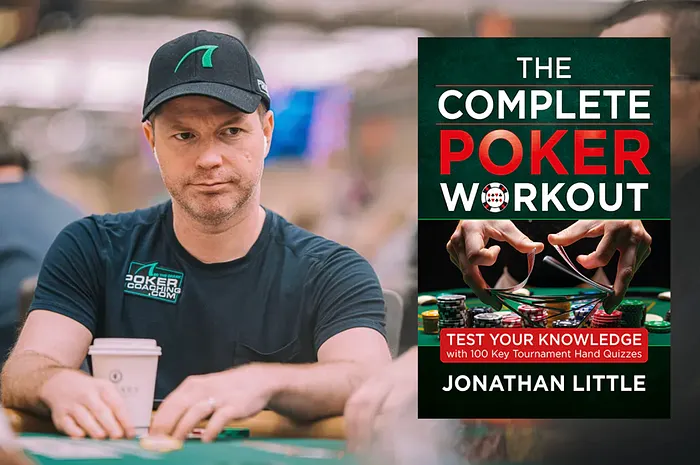
A new poker study resource hit the shelves on December 5 with the release of The Complete Poker Workout, the latest book from renowned poker professional and coach Jonathan Little. Published by D+B Publishing, the book takes a practical, interactive approach to tournament poker improvement rather than relying solely on theory.
Instead of long-form strategy explanations, The Complete Poker Workout challenges readers with 100 carefully designed tournament hands. Each scenario asks players to actively quiz themselves on critical aspects of the game, including preflop ranges, postflop decision-making, opponent adjustments, bubble dynamics, final-table play, and more. The goal is not just to reinforce what players already know, but to uncover gaps in their understanding that may be holding them back.
At 392 pages, the book offers substantial content and retails for $34.95, with discounted pricing currently available. It is offered in paperback, ebook, and audiobook formats, with the Audible version priced at $13.96, making it accessible for different learning preferences.
According to the book’s description, The Complete Poker Workout is built around the idea that most tournament players struggle to objectively evaluate their own skills—especially in high-pressure situations. By presenting 392 targeted questions tied to 100 hands, all organized by stack size, the book aims to expose blind spots while helping players identify both their strengths and areas that need focused improvement.
A Practical Review of The Complete Poker Workout
Jonathan Little has long been a respected voice in poker education, with previous works such as Secrets of Professional Tournament Poker having helped countless players refine their games. His experience as a player, coach, and author is evident throughout this new release.
What sets The Complete Poker Workout apart is how closely it mirrors the experience of actually playing poker. Each hand is layered with multiple decision points, and Little provides detailed explanations after the reader commits to an answer. While real-world experience remains irreplaceable, this format comes impressively close by forcing active engagement rather than passive reading.
The hand selection is broad and well thought out, covering situations like value betting rivers, navigating coordinated boards, extracting maximum value from weak ranges, and dozens of other common but complex tournament spots. With nearly 100 scenarios in total, repetition never feels stale.
The structure also allows readers to move at their own pace. Whether working through a couple of hands per day or tackling longer sessions, the book naturally lends itself to consistent, focused study without feeling overwhelming.
Overall, The Complete Poker Workout is well-suited for a wide audience. Newer and recreational players will find it invaluable for building a stronger foundation, while experienced tournament players can use it as a diagnostic tool to keep their skills sharp and identify leaks they may not even realize they have. As a modern poker study guide, it succeeds in turning learning into an active and engaging process rather than a passive one.